
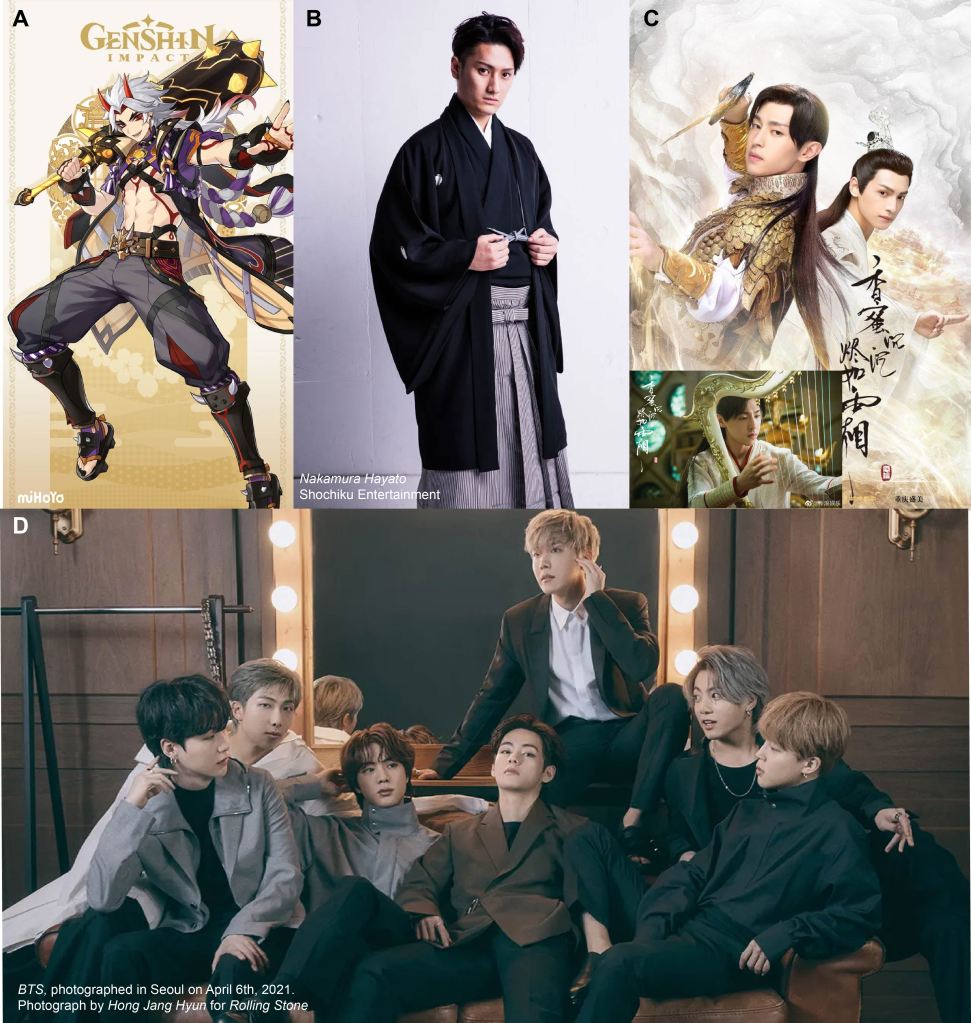
How men are portrayed in East Asian pop culture. (A) A character from Chinese role-playing video game, Genshin Impact. Arataki Itto is a member of red demon race and was the buffest dude in the game. He would have looked closer to Red Hulk if he were in a Western video game. (B) Japanese Kabuki theater actor, Nakamura Hayato. He will play Yamato Takeru in Super Kabuki, 2024. (C) Chinese Wuxia TV series, Ashes of Love (2018). While not wielding a sword, the main hero plays a string instrument. (D) K-pop superstar boy band, BTS. Currently, BTS is on hiatus because the members are serving their time in the South Korean Military.
About a year ago, one of my friends was talking about how Chinese game company, Hoyoverse, had “failed,” in the eyes of the Western audience, to create a properly “buff” character. Some commented on these developers coming from many East Asian countries, (China, Japan, Korea, Taiwan, Singapore, etc.) some graduating from Western universities, yet still struggled to see the value and appeal in a buff man.
Even in fandom spaces, there is a disparity between East Asian sides of fandom and the Western side. Western fans have a noticable tendency of “beefing up” male characters from manga and anime (some with canonical appearances that are the opposite of muscular…) While East Asian fans like drawing male characters just as slender, if not more slender and delicate-looking than canonically shown in manga and anime. At the extreme, men are made as slim as a fairy to where they are indistinguishable from a flat-chested girl.
In other words, East Asian people tend not to see the appeal of your average Marvel Comics male protagonist. From ancient times, they preferred the more slender, educated, and “cultured,” gentleman over a sweaty, buff and muscular warrior.
One such example is a sword-fighting prince named Yamato Takeru in Japanese mythology. The “Yamato” is in reference to Japan’s old name, while Takeru translates to, “the Brave,” in this context. In the original myth, he was often described as being, “so handsome that people frequently mistook him as a girl,” which was how the epitome of male beauty was described in ancient Japan. In one of his adventures, Yamato Takeru went to a banquet disguised as a beautiful woman to ambush the local bandit king. When you hear this story, it’s hard not to see the similarity to Norse Mythology’s Loki, famously implied to be a genderfluid god. The difference is that Yamato Takeru is a righteous hero and frequently compared to King Arthur by scholars, while Loki is more villainous and better described as an antihero. Norse god Loki is popular in US pop culture, but not a popular name among parents. They more often name their son “Arthur,” after The Legend of King Arthur. “Arthur” ranks #140 in popular baby boy names in the 2023 US Census, but “Loki” ranks outside of top 1000. Takeru is an equivalent boy’s name to Arthur in Japan in terms of popularity. (It ranked #82 in popular baby boy’s name in Japan in 2020).
When we talk about male beauty, you cannot skip Koreans. K-Pop fans may already be familiar with how their popstars always strictly fit the beauty standards– pale, tall, slender, with amazing fashion. Idols are always trained to have excellent singing and dancing skills.
American reporters tend to casually describe, for example, BTS’ choreography and style as “so gay”. American media tends to over-emphasize the sexuality of idols who have an androgynous appeal. David Bowie faced this in the 70s, and now Harry Styles. In Korea, the media has no issues separating stunning artistic ability and fashion sense from sexuality. After all, artistic expression and sexuality are two separate things. Men like BTS, are truly considered as the ideal boyfriend by female fans. They are not made for gay men, or the fujoshi (women who enjoy reading gay love stories)– despite what Americans seemingly perceive otherwise. These K-Pop boy bands are undoubtedly marketed towards a mainstream audience.
When we talk about Japan and Korea, China naturally comes next. When the sons of Chinese immigrants excel at playing an instrument, Americans dismiss it as having “Tiger Parents,” that forced music on their child just for the college resume. However, in the minds of those Chinese parents, they see their child as a modern version of an ancient Chinese cultivator, with flowing white robes and breathtaking guqin (Chinese seven-stringed instrument) playing. In China, a popular genre called Wuxia, which translates to, “martial hero,” has existed for a long time. Wuxia worldview is best comparable to Game of Thrones world in U.S. pop culture. Wuxia portrays ancient Chinese cultivators fighting against evil with great martial art mastery and professional musical ability. Those cultivators also possess other artistic skills; they paint the scenery sitting under the peach blossom trees and compose poems in perfect calligraphy under the blue moonlight. However, Wuxia films stage those scenes cultivators playing a string instrument (or a flute) with the greatest care and aesthetics, and they are a national hero in China. Many parents see them as the ideal man for their child to grow into. Those parents don’t have any issue associating a scholarly demeanor and musicianship with manliness.
The worldwide popularity of BTS, particularly in the Western World, suggests that the American “Buff Culture” is causing us to underestimate the power of beautiful and artistic men. We Americans need to consider the culture we force on young men that prevents them from pursuing performing arts— even pursuing visual and literary arts.
 Fredpinion
Leave a comment